Miniature strain gage is advantageous in applications that benefit
from small size and higher resistance
MALVERN, Pa.--(BUSINESS WIRE)--
The Micro-Measurements® brand of Vishay Precision Group, Inc.
(NYSE: VPG) (www.micro-measurements.com),
industry experts in the design, development, and manufacture of
resistive-foil sensors for high-precision strain, high-stress and force
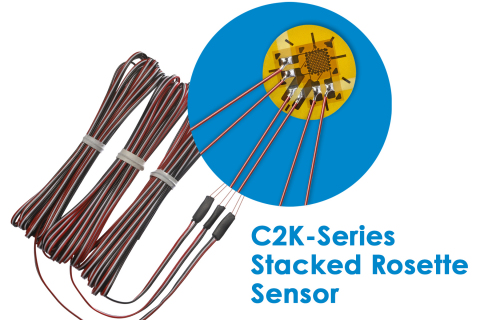
mechanism measurements, today introduced the G1350 C2K-Series strain
gage, a miniature stacked rectangular rosette sensor built to meet the
developing need for precise, consistent, and reliable stress analysis of
PCBs, even in severe environments. The G1350 is designed to detect PCB
surface strains at critical locations in consumer electronics. The
miniature strain gage is particularly advantageous in applications that
can benefit from its small size and higher resistance of 120 ohms and
350 ohms.
This press release features multimedia. View the full release here:
https://www.businesswire.com/news/home/20180927005192/en/
(Photo: Business Wire)
The G1350 is ideal for applications in Structural Health Monitoring
(SHM), Industrial Internet of Things (IIoT), autonomous vehicles,
instrumentation & control, machinery & equipment, motion control,
Industry 4.0, robotics, smart cities, smart manufacturing, smart
infrastructure, wearable electronics, and wireless applications.
Designed using the same rigorous standards as traditional
Micro-Measurements gages, the new line of C2K series strain gages is
based upon advanced technology manufacturing processes that allows high
resistance in small-sized gage patterns. The uniaxial linear stacked
rosette C2K-06-G1350-350 features an active grid length of just 0.040”
and an overall matrix of 0.20”diameter to allow spot-on installation on
surface-mount components. The 3 meters of pre-attached three-conductor
cable is built to ease and speed-up installation processes by
eliminating the need of lead wire soldering after bonding.
Miniaturizing consumer electronics will result in higher component
density, increased thermal stresses, new requirements for surviving
repeated loadings, and a larger need for impact stress survival. In
order to meet these requirements, precise knowledge of strains in the
PCB and on-board components is a must. The most accurate, swift, and
cost-effective manner to detect strains on a PCB is through strain gage
measurement, which can also be used in developing loading fixtures and
test plans to optimize the testing phase.
The new strain gage features a Modified Karma, or K-alloy (C2K), and an
epoxy overcoat for grid encapsulation. The second generation of the
G1350 is based on K-alloy, with its extensive areas of application,
representing a vital member in the family of strain gage alloys for PCB
testing. Categorized by strong fatigue life and excellent stability,
K-alloy strain gages can be exposed to temperatures as high as +150°F
(+66°C). An inert atmosphere will strengthen stability and extend the
useful gage life at high temperatures. Among its other advantages,
K-alloy offers a much flatter thermal output curve than A-alloy,
allowing more precise correction for thermal output inaccuracies at
temperature extremes. Like constantan, K-alloy can be
self-temperature-compensated for use on materials with different thermal
expansion coefficients. K-alloy is the normal selection when a
temperature compensated gage is required that has environmental
capabilities and performance characteristics not attainable in A-alloy
gages.
As required by standards in the electronics industry, PCAs must be
tested to determine if the design can withstand the rigor of
manufacturing, packaging, transporting, and day-to-day use of electronic
devices. Some of the methods in the process in which strain gages are
used for printed circuit assembly testing include: ensuring appropriate
surface preparation materials are on hand, selecting an adhesive,
selecting a protective coating that will resist environmental
conditions, and selecting the measurement instrumentation.
Further information about Micro-Measurements strain gages and technical
support is available at www.micro-measurements.com.
Follow Micro-Measurements at www.strainblog.com
or on twitter @strain_gage
About Micro-Measurements
Micro-Measurements, a Vishay Precision Group, Inc. (VPG) brand, is
dedicated to the development, manufacture, and marketing of
resistive-foil sensors for high-precision strain measurement.
Micro-Measurements offers a full complement of strain gages, PhotoStress® equipment
and coatings, data acquisition systems, and supplies necessary to obtain
accurate, reliable stress data. Our products are used throughout the
industrialized world — both in the practice of stress measurements
analysis and as the sensing elements in a wide variety of transducers
for measuring physical variables (weight, force, torque, pressure,
etc.). More information about Micro-Measurements is available at www.micro-measurements.com.
About VPG
Vishay Precision Group, Inc. is an internationally recognized designer,
manufacturer and marketer of: components based on its resistive foil
technology; sensors; and sensor-based measurement systems specializing
in the growing markets of stress, force, weight, pressure, and current
measurements. VPG is a market leader of foil technology products,
providing ongoing technology innovations in precision foil resistors and
foil strain gages, which are the foundation of the company’s force
sensors products and its weighing and control systems. The product
portfolio consists of a variety of well-established brand names
recognized for precision and quality in the marketplace. To learn more,
visit VPG at www.vpgsensors.com.
Micro-Measurements and PhotoStress are registered trademarks of VPG

View source version on businesswire.com: https://www.businesswire.com/news/home/20180927005192/en/
Micro-Measurements Sales:
[email protected]
or
VPG:
Reynee
Tung, +1 (919) 374-5515
Director, Global Marketing Communications
[email protected]
or
MEDIA
INQUIRIES:
PR
ICR Inc.
Christine Hardman, +1
(646) 277-1286
[email protected]
Source: Vishay Precision Group, Inc.